AI Is Much Bigger Than You Think
AI is 4x-5x Bigger Than You Think
Key Takeaways
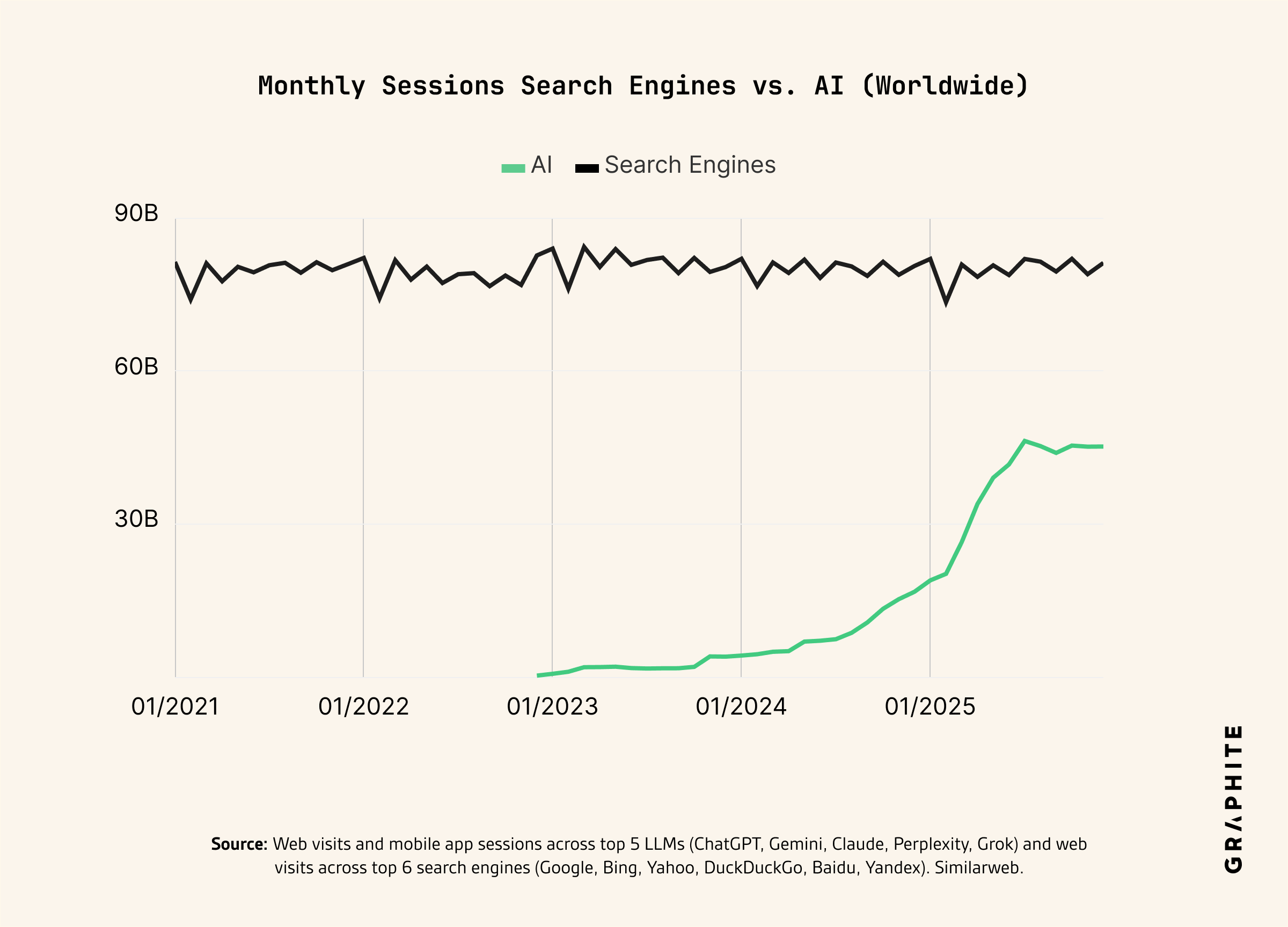
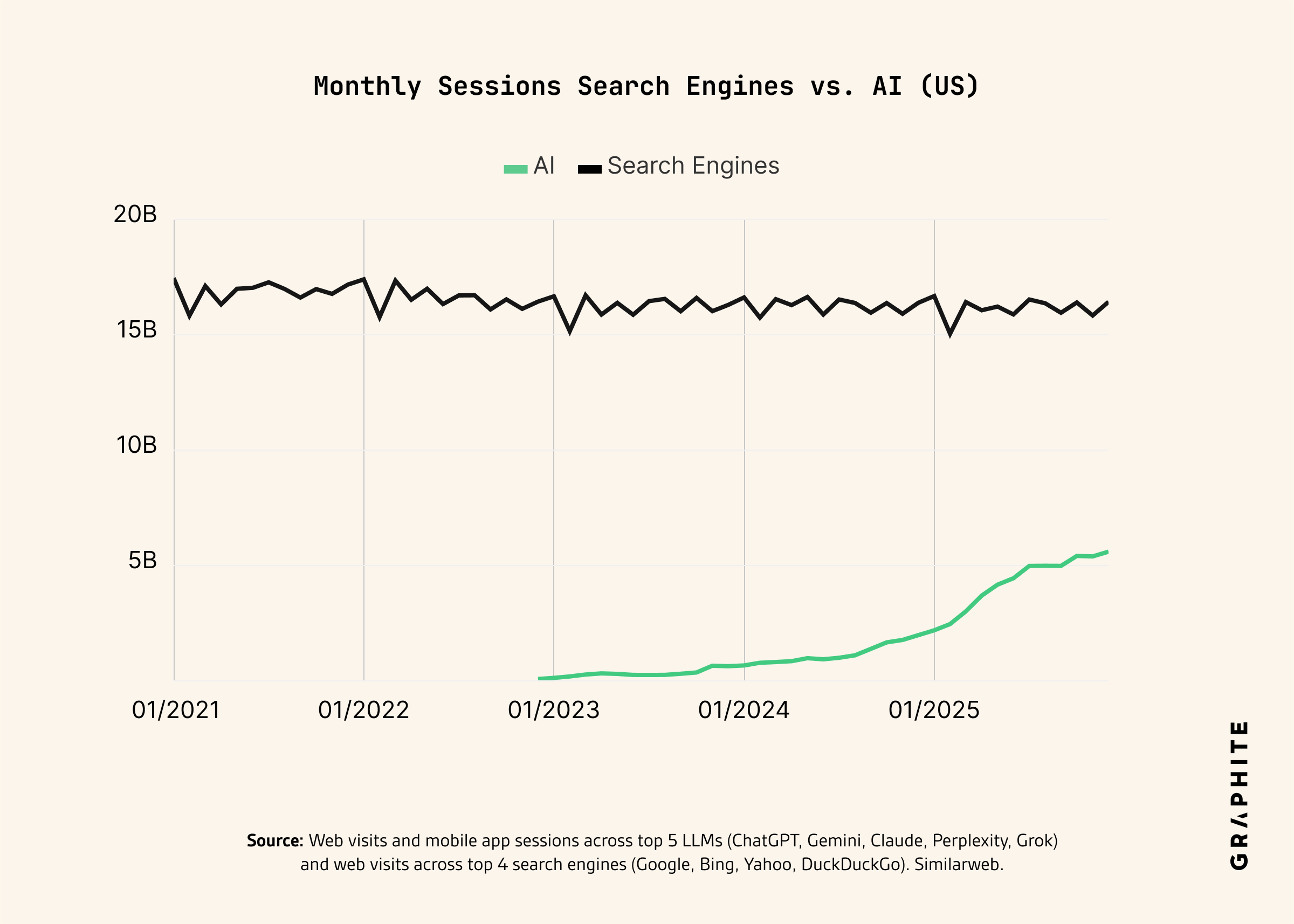
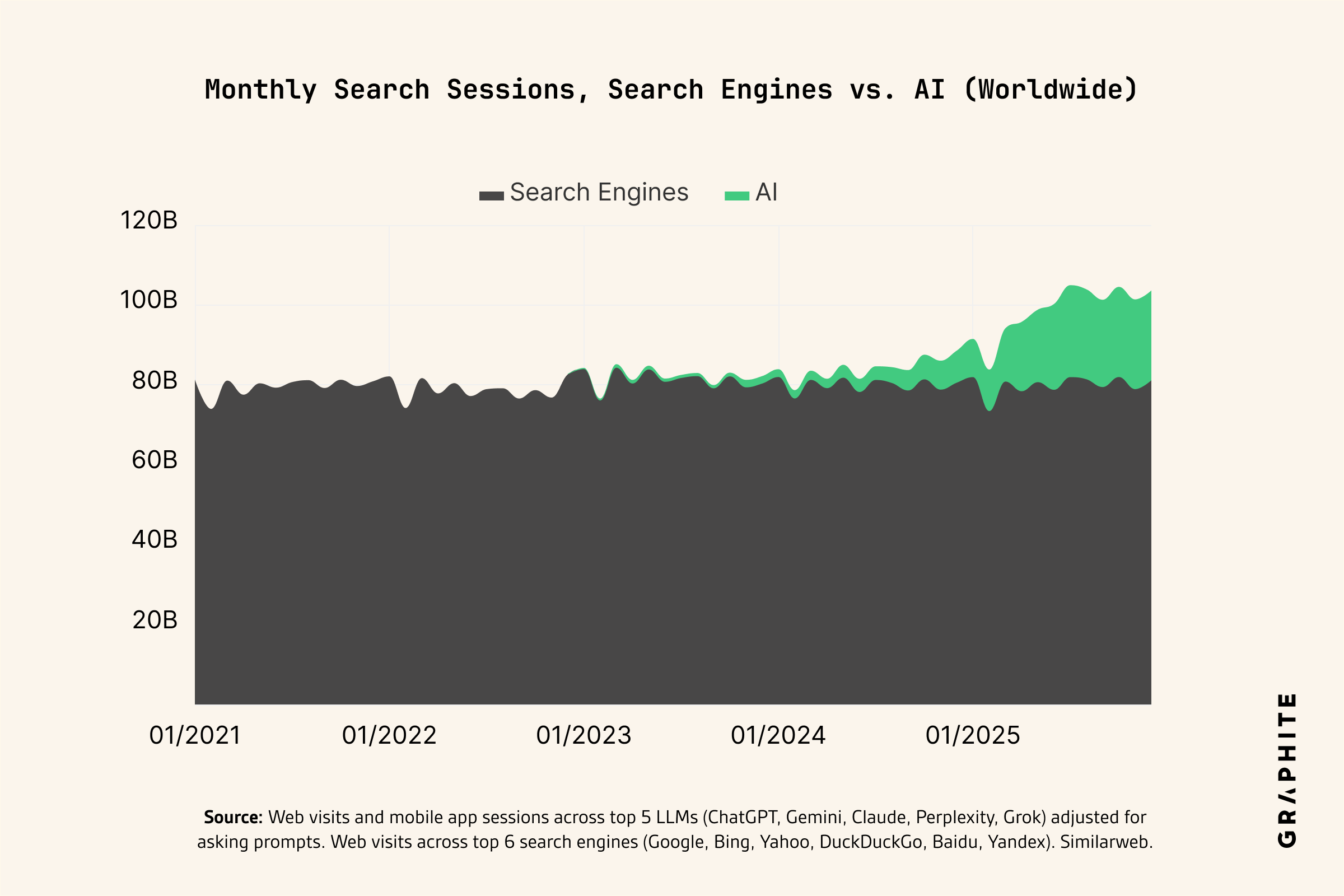
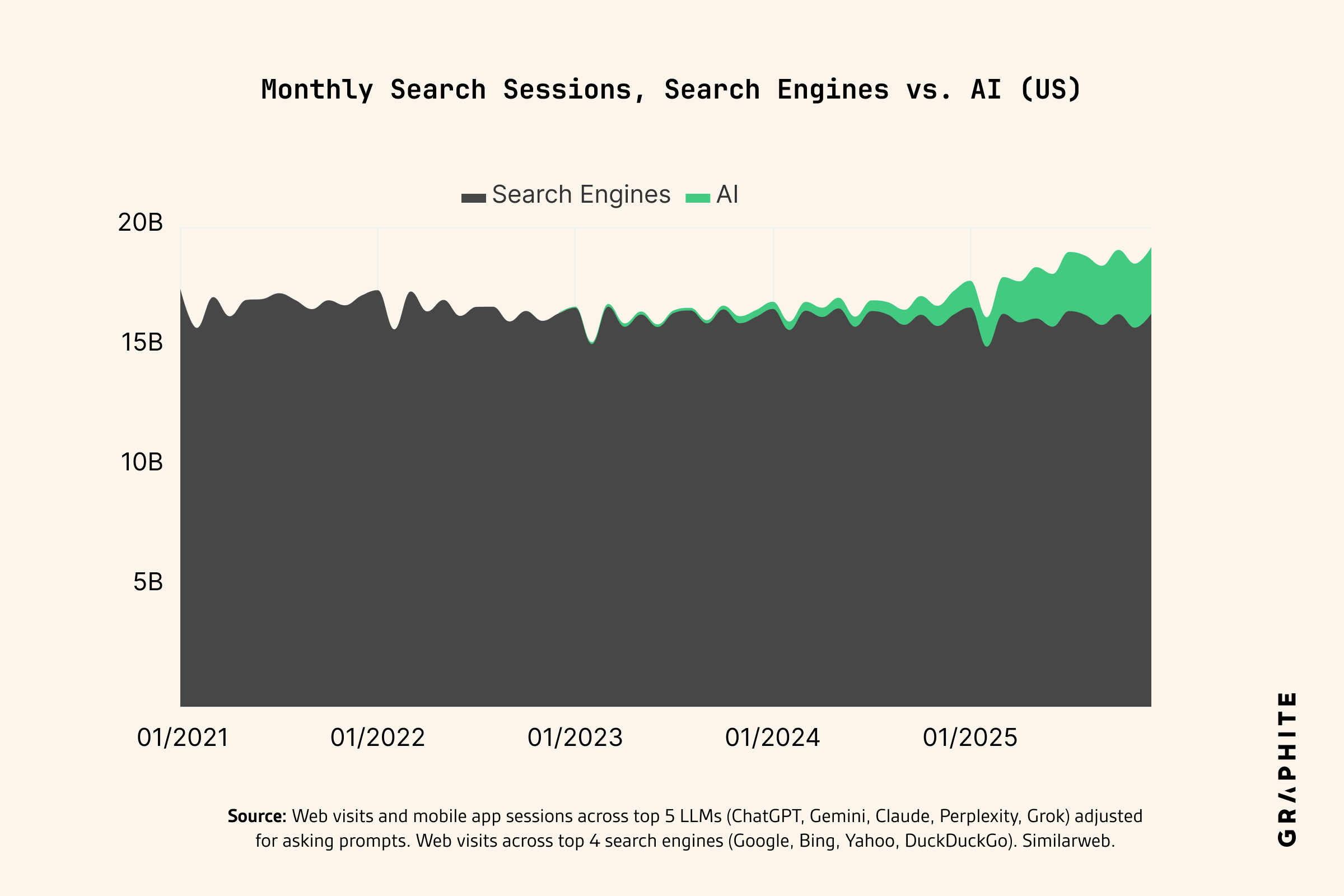
Monthly sessions of AI are now 56% the size of search worldwide and 34% in the US, 4x-5x larger than previous reports that only include web data.
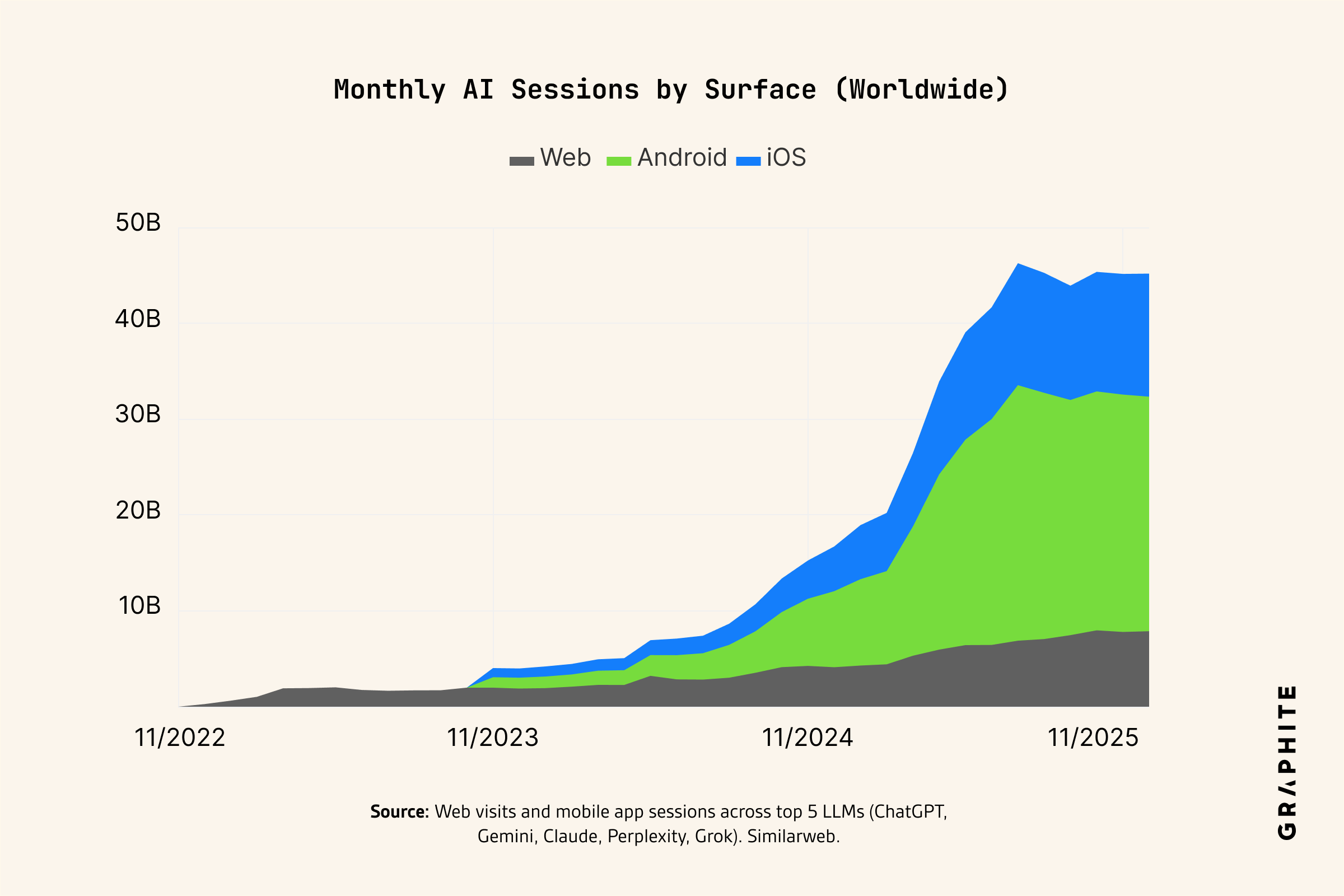
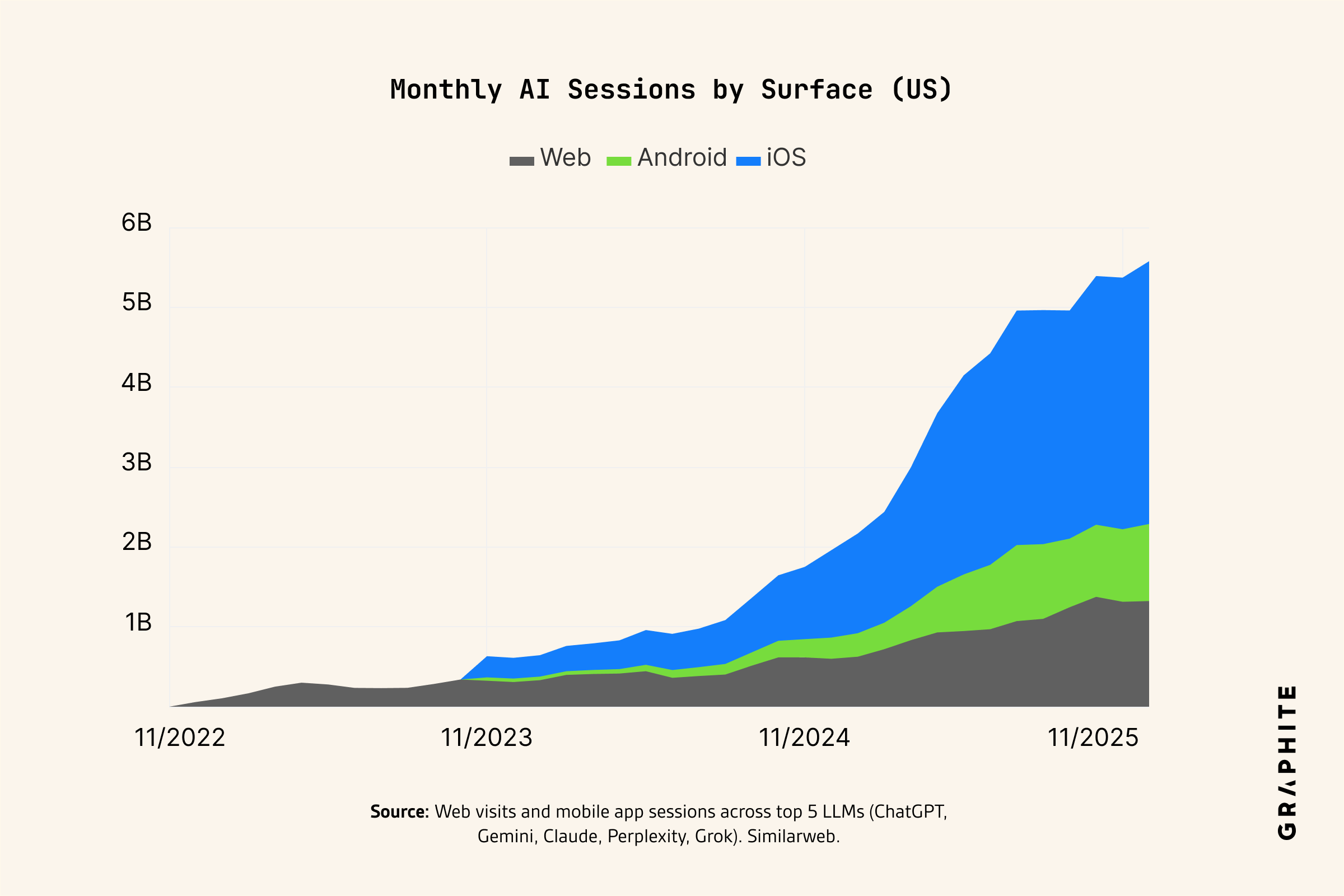
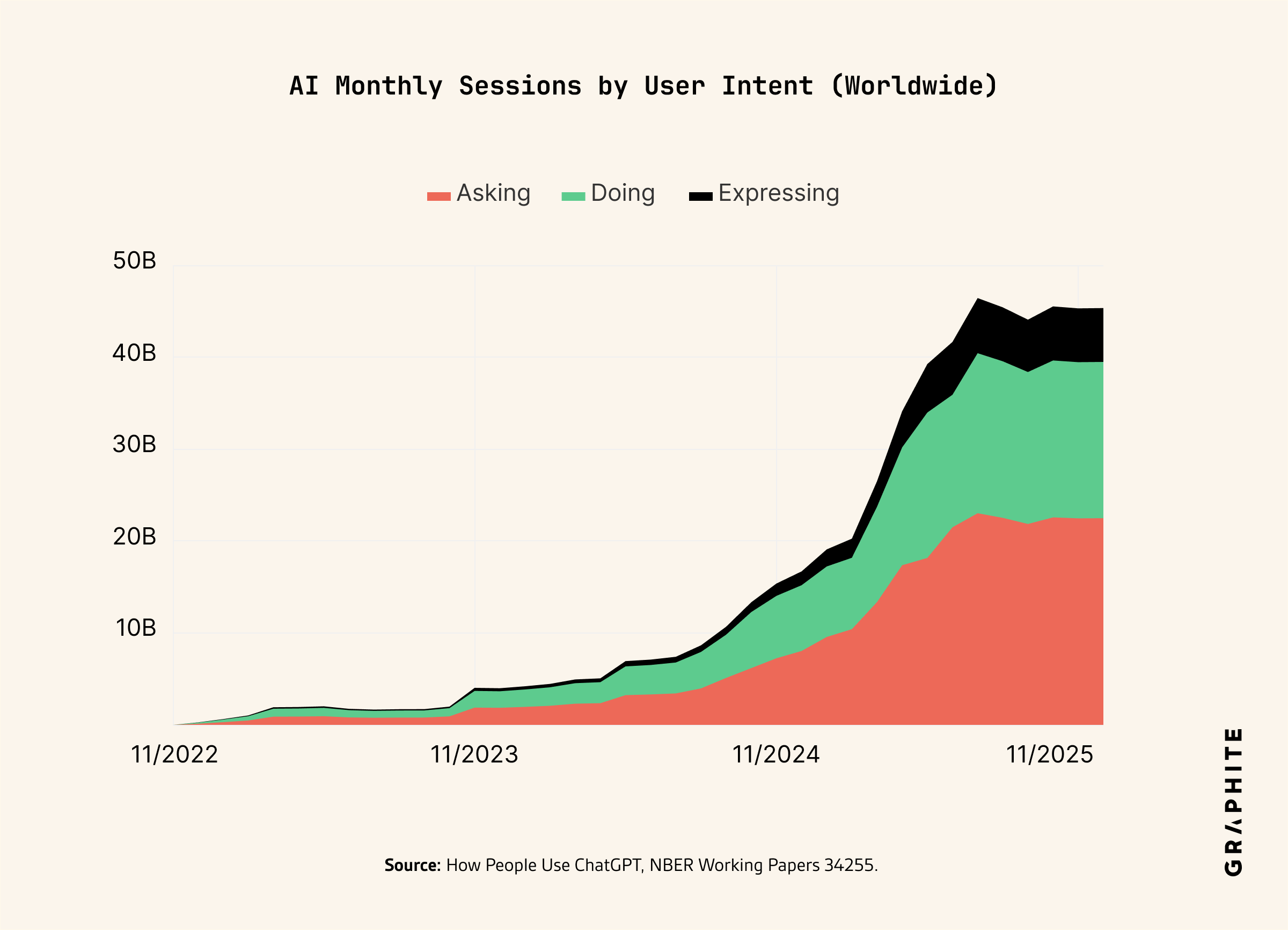
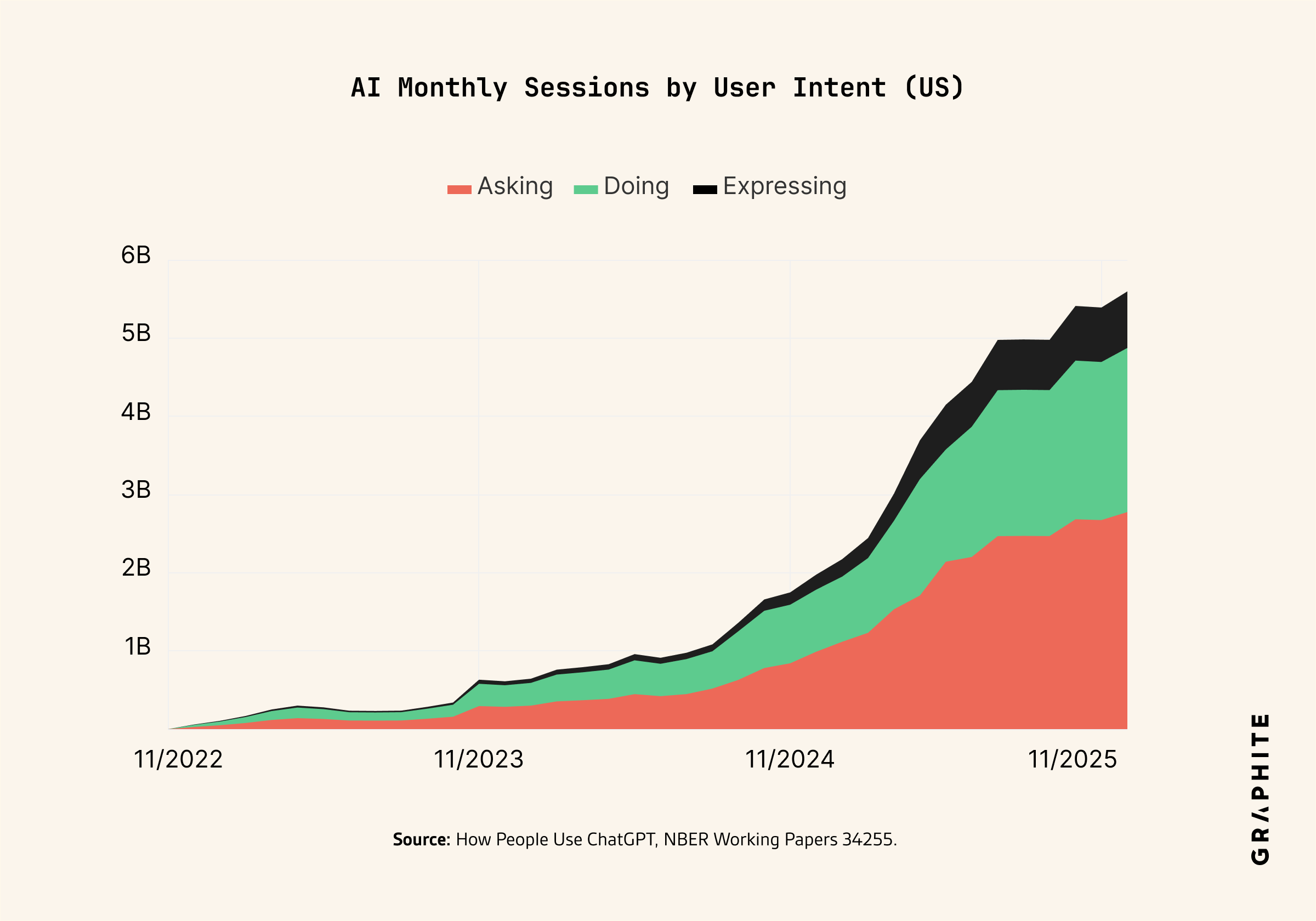
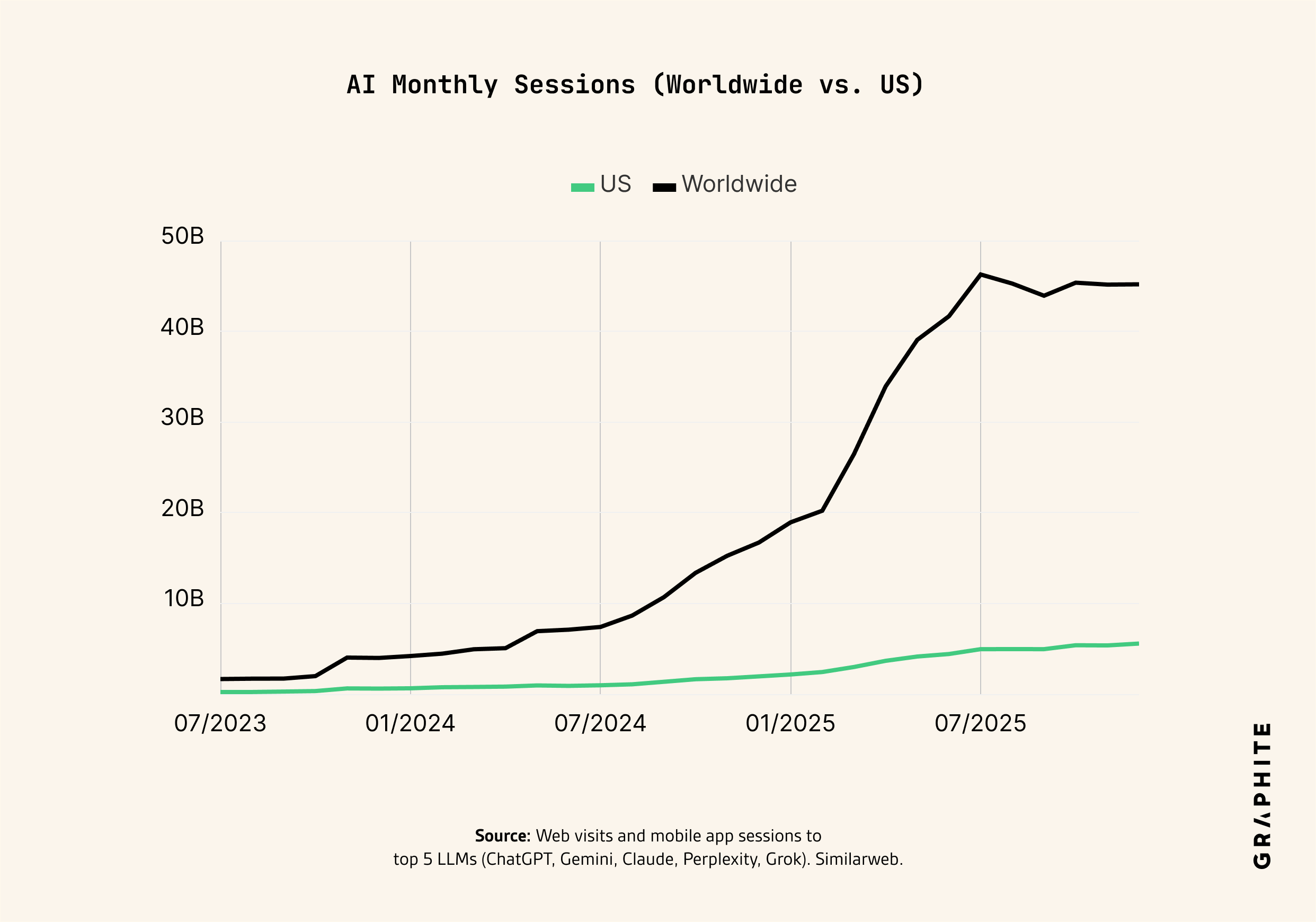
AI now receives 45B monthly sessions worldwide, and 5.4B monthly visits in the US.
Search-related usage of AI (Asking prompts) is now 28% the size of search worldwide and 17% in the US.
AI has grown even larger across the World than in the US, with usage worldwide 7x that in the US.
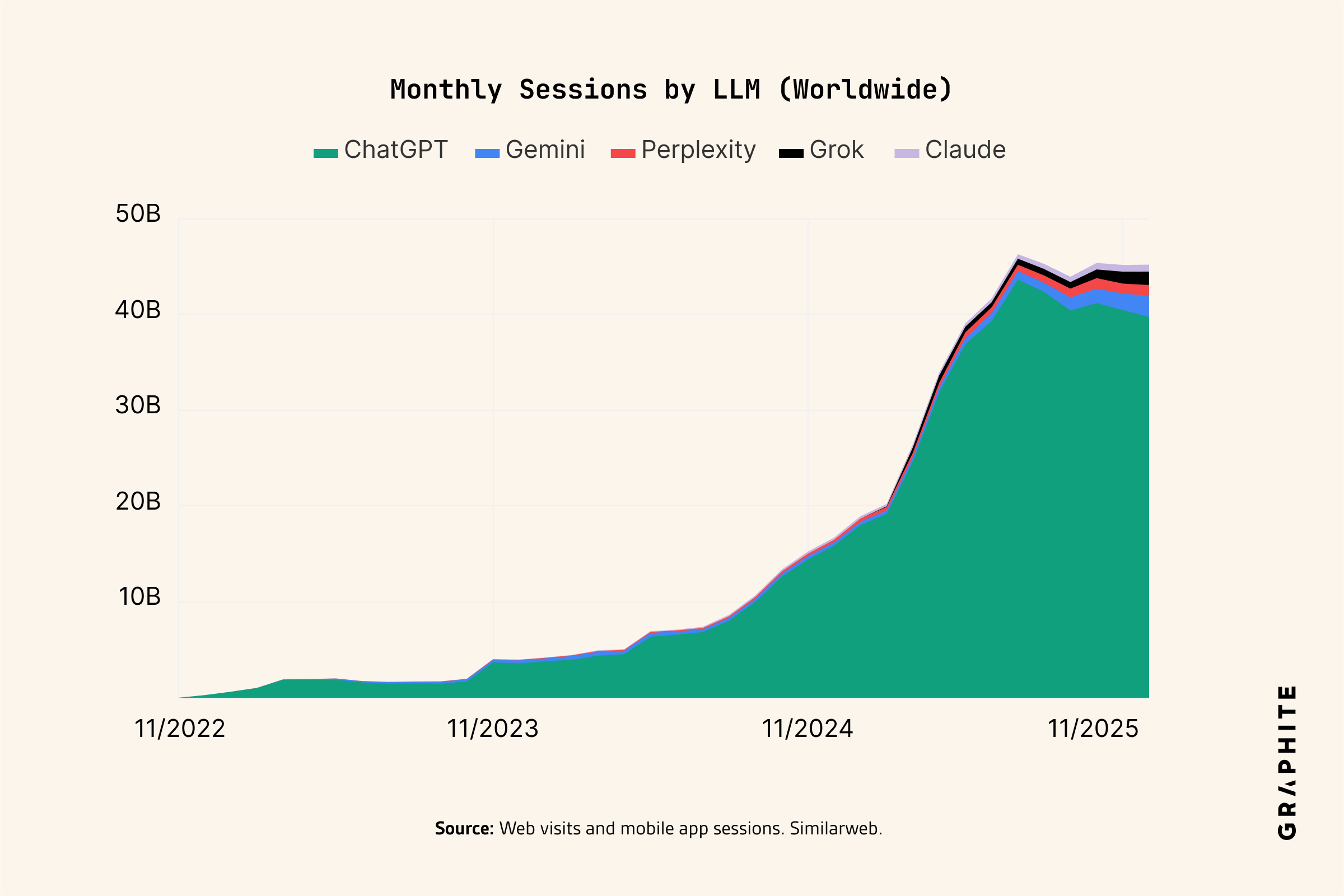
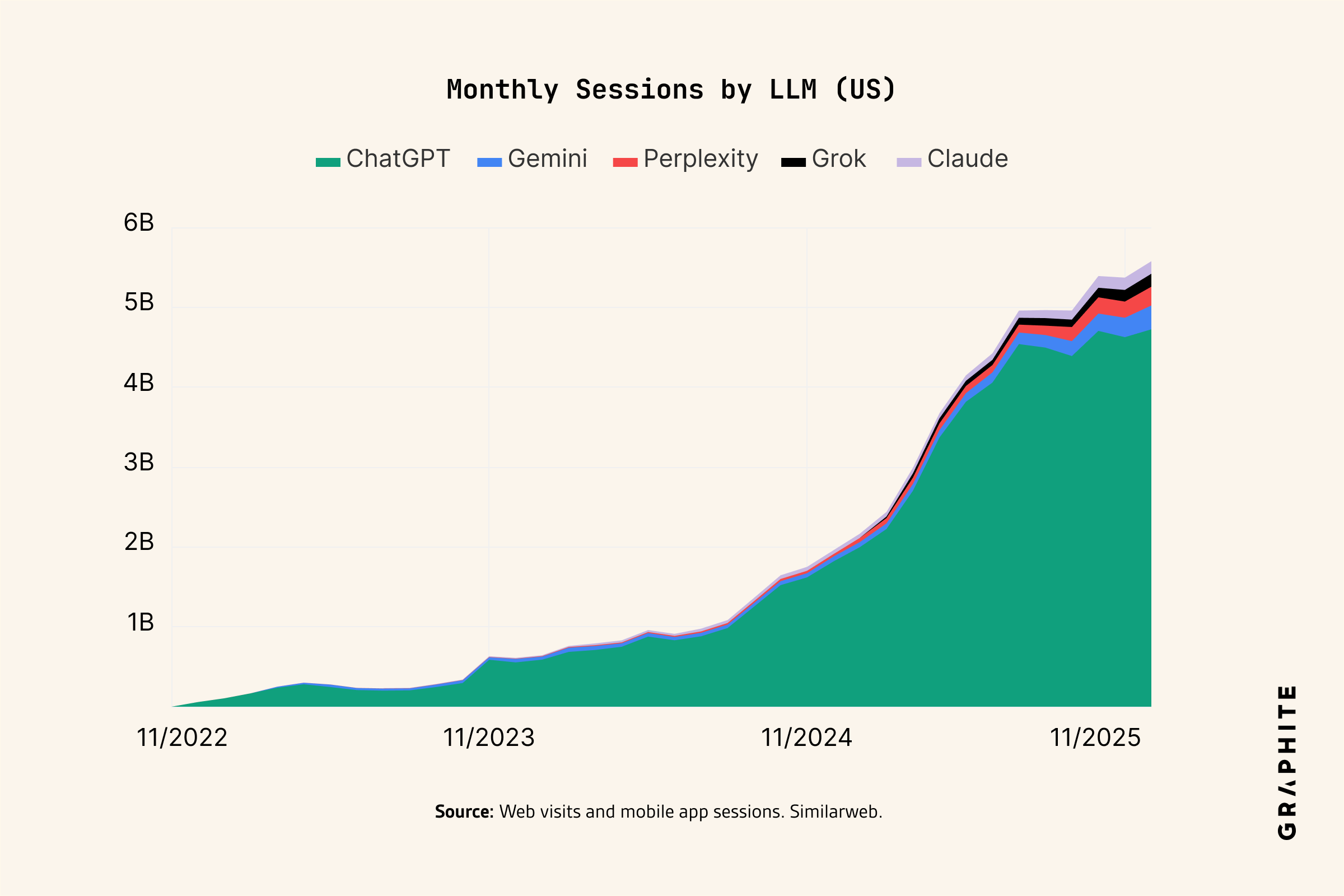
Worldwide sessions of AI have plateaued since July 2025 across all LLMs. However, usage of AI continues to grow in the US, with December 2025 +300% vs. December 2024.
Search has not decreased, and neither has Google. Instead, the pie has gotten bigger. Total usage of search combining search engines and search on LLMs has increased by 26% worldwide and by 16% in the US, comparing 2025 with 2024.
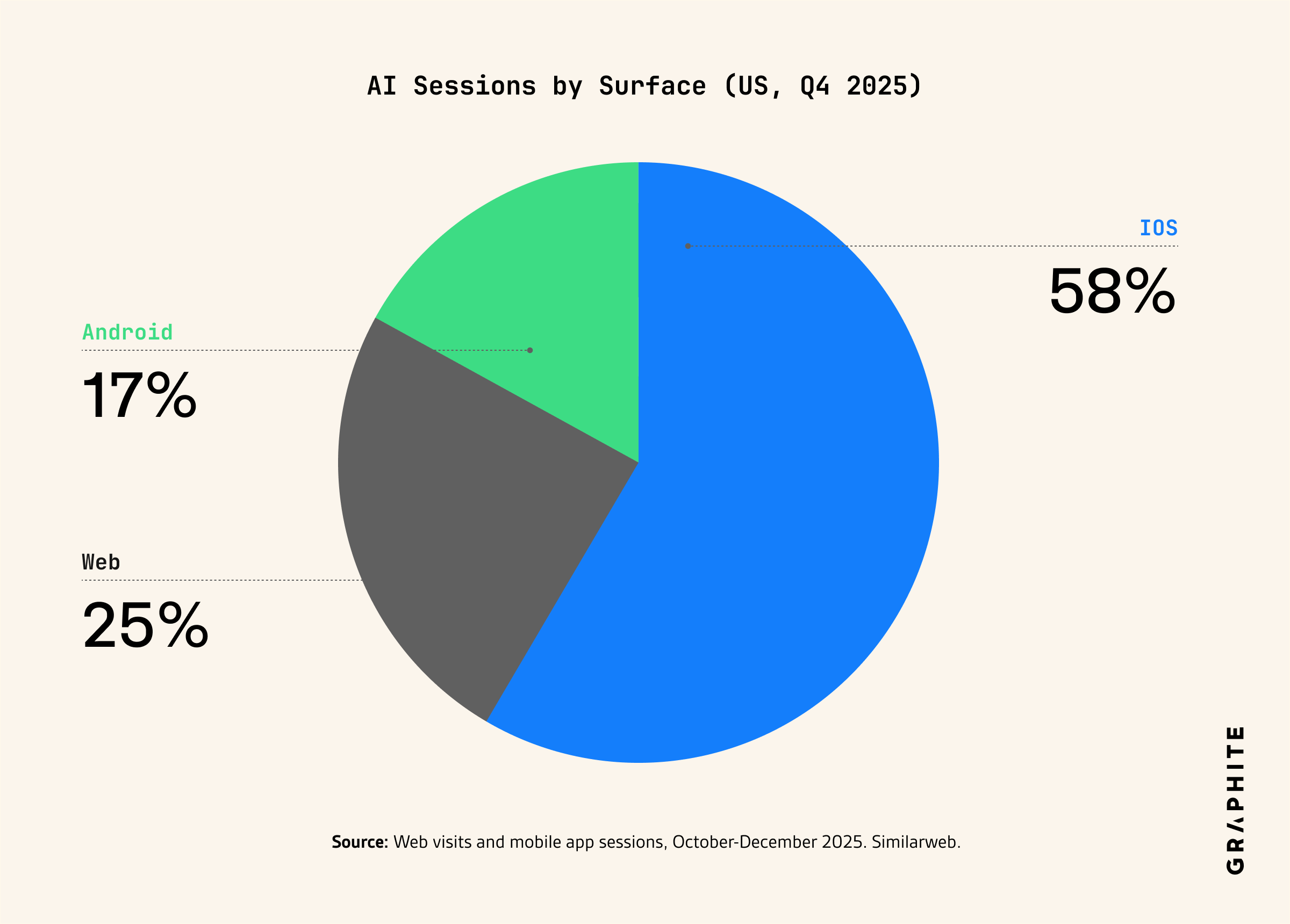
83% of AI usage occurs in mobile apps worldwide, and 75% in the US.
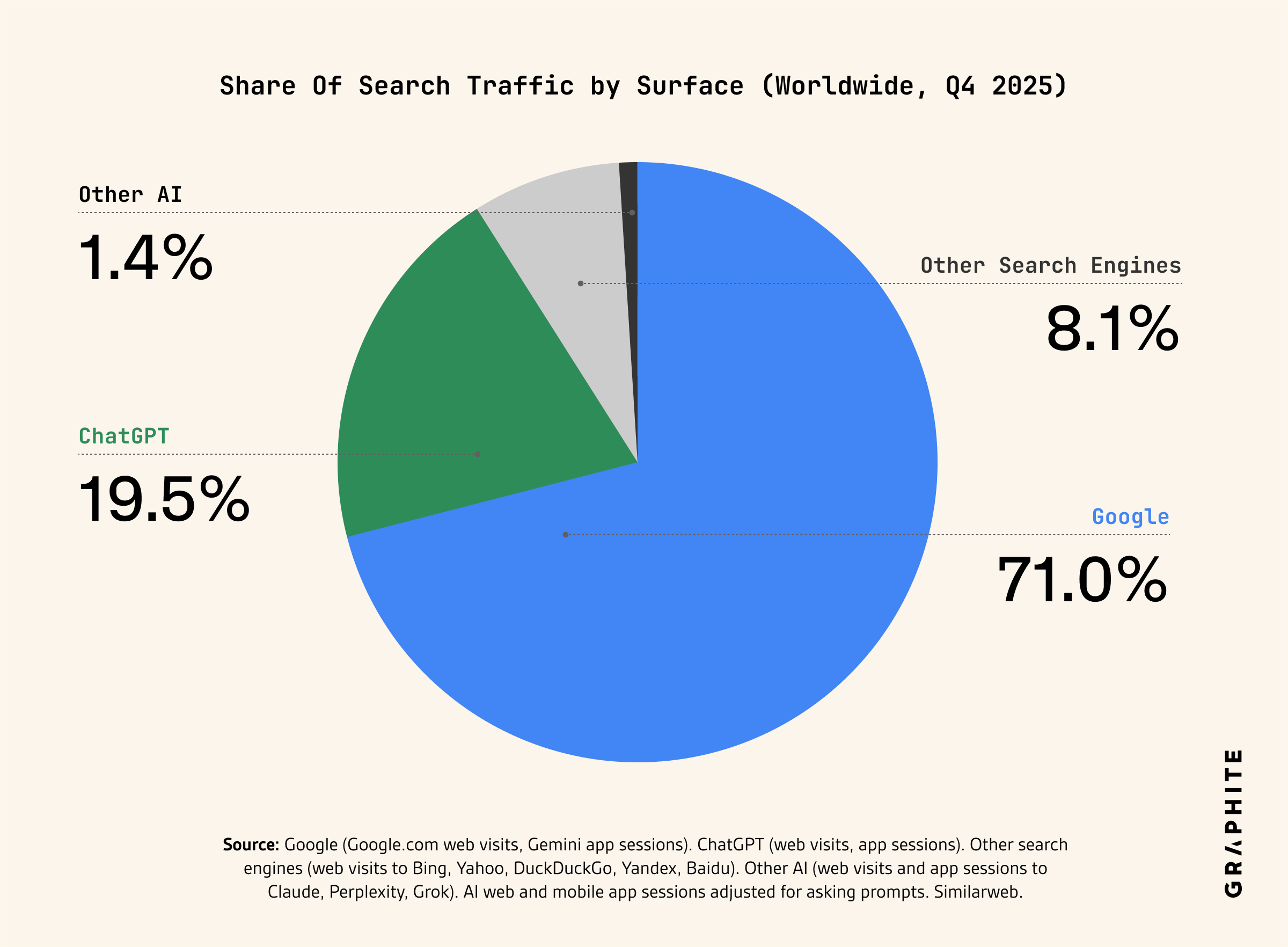
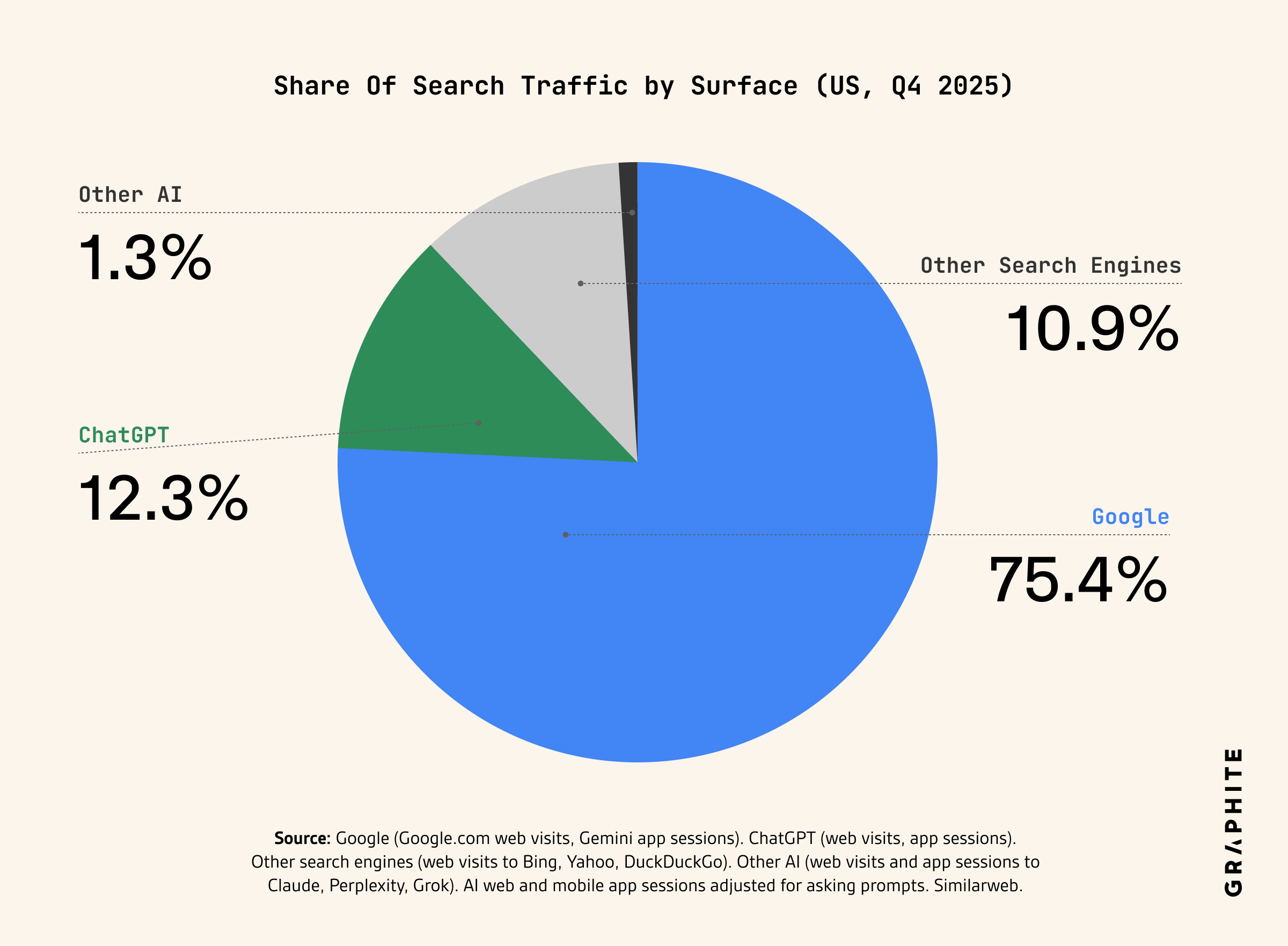
ChatGPT now accounts for 20% of search-related traffic worldwide and 12% in the US.
Contents
Predicting the AI Adoption Curve
The Technology Adoption Curve
When ChatGPT launched in November 2022, it caused dramatic changes in the landscapes of AI, search, and marketing. After only 2 months, ChatGPT became the fastest-growing consumer app in history. As of October 2025, ChatGPT sees over 800M weekly active users and 2.5B daily prompts (source).
Over the last 100 years, a series of technological innovations has transformed society faster than at any other time in history. The discovery of nuclear energy, the invention of computers, the internet, search engines, social media, mobile phones and apps, and now AI. Each technological innovation has a different adoption lifecycle and timeline. Early in the adoption curve of a new technology shift, people attempt to predict the adoption curve. With each new technological innovation, many people predictably overstate and exaggerate the adoption and rate of change.
The Rise of the Internet & Search
In the 2000’s, search and the internet were the largest technological shifts, with Google at the forefront of this change. Google first launched in 1998. 28 years later, Alphabet, Google’s parent company, is now one of the 10 most valuable companies in history with a market cap of over $3 Trillion (GOOG, source). For years, Google has dominated the search engine market with 88% market share. But many people now use AI to search and discover. Products like ChatGPT, Perplexity, Grok, and Claude directly compete with Google.
“The Web Is Dead” Circa 2010
We have seen this movie before. In 2008, Apple introduced the ability to create mobile apps. Early in the adoption lifecycle of mobile apps, many people claimed that mobile apps would soon overtake the web and that the web would eventually die as a result. Early in the technology adoption cycle of mobile apps, Wired magazine argued in September 2010 that “The web is dead. Long live the internet.”
Mobile apps did eventually reach the potential that was claimed. But the adoption cycle was overstated early. People continue to use the web, and usage of mobile apps is incremental. The web never died, the pie just got much bigger.
We have always believed the hype around the long-term potential of AI adoption, but we have remained skeptical of claims of how rapid the change is or will be. Many headlines have claimed that Google and search are now dying, caused by the rapid growth of AI. However, we recently published a study debunking the myth that search is dying.
Some say that AI has the fastest adoption curve of any technological innovation ever. Some claim that AI will overtake search in as little as 1 to 4 years. However, the methodologies of these forecasts are typically not disclosed and simply say, “based on our projections…”.
We did not believe the hype and assumed the claims of AI’s size and growth curve to be overstated. We originally sought to evaluate our hypothesis that most claims about the usage of AI were overstated, and that usage of AI was smaller and growing more slowly. However, upon closer inspection of the data, we found that not only are the claims that AI may soon overtake search not overstated, they are understated.
AI vs. Search: Share of Usage
Usage of AI Is Now 56% the Size of Search Worldwide
- Since July 2025, Worldwide visits to AI reached 56% the size of search.
- Usage of AI has plateaued worldwide since July 2025. However, in the US, it continues to grow rapidly.
- We do not attempt to forecast the timeline for when AI surpasses search, given the variability of its growth curve. However, given the rapid growth of AI relative to prior technological innovations and the potential that AI has to transform the world, we do expect the use of AI to surpass search in the near future.
- “AI” considers the top 5 LLM products (ChatGPT, Gemini, Perplexity, Grok, and Claude) and combines visits on the web and sessions on mobile.
- For “Search Engines,” we combine the website visits of the top 6 search engines: Google, Bing, Yahoo, DuckDuckGo, Yandex, and Baidu.
- Users search and discover on many other surfaces, such as commerce platforms (Amazon), social networks (Instagram), and other verticals. For the purpose of this study, we do not include these other surfaces.
Usage of AI Is 34% That of Search in the US
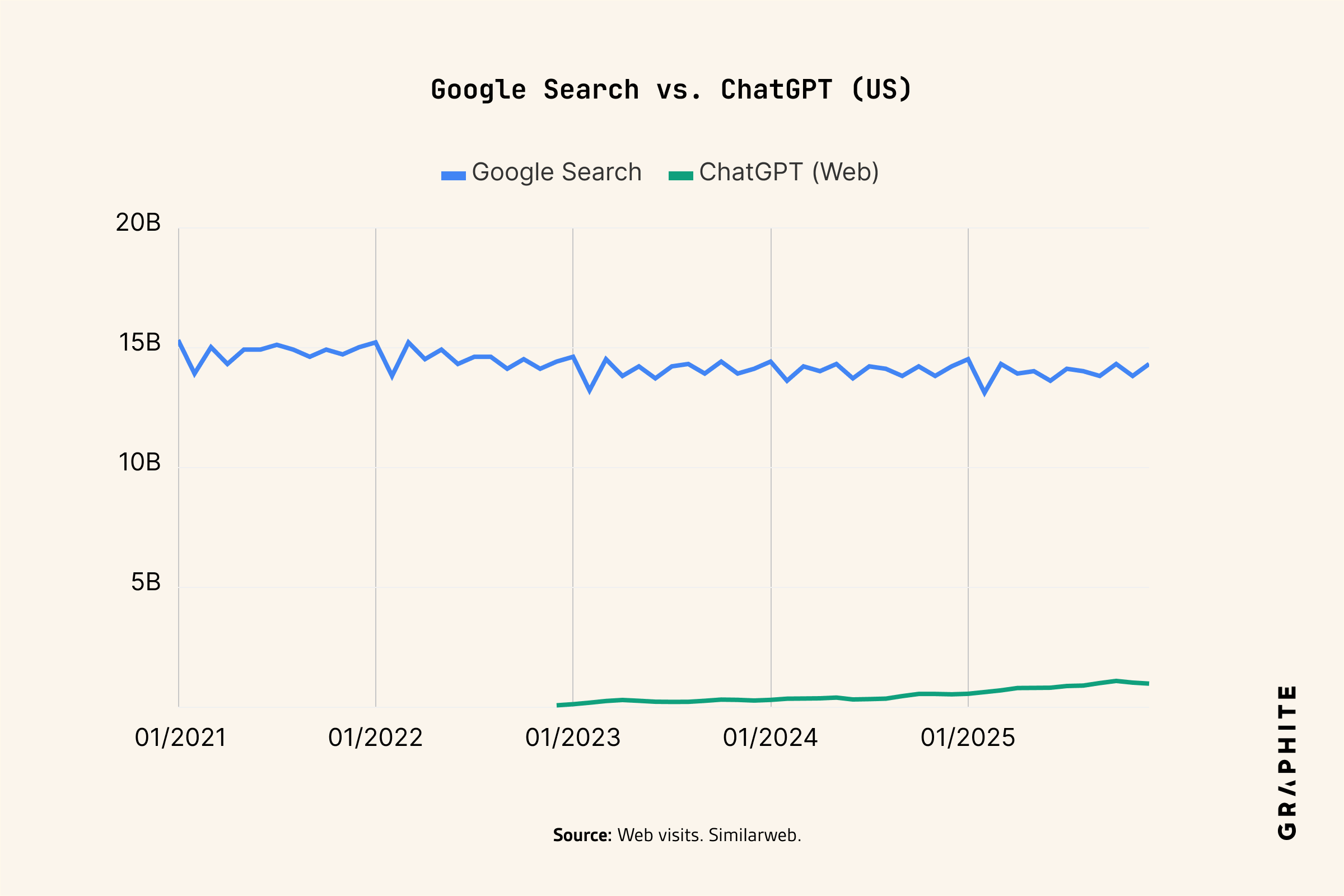
Google Search vs. ChatGPT.com Web, an Incomplete Picture
Previous projections have compared visits to Google Search and web visits to ChatGPT. The projections show that while ChatGPT has a small fraction of the traffic of Google today, eventually, ChatGPT will grow to overtake Google Search as it inevitably declines. There is no stated methodology for these forecasts.
These analyses and projections are flawed in the following ways.
- Some projections indicate that monthly Google Search visits in the US averaged 4B in January 2021, then decreased to 3.7B in July 2024. However, data from Similarweb show a nearly 300% difference, with 15.3B visits in January 2021 and 14.4B in January 2024. In March 2025, Google publicly announced that as of January 2025, “We already see more than 5 trillion searches on Google annually.” These data further validate Similarweb’s data.
- The majority of usage of ChatGPT is via mobile apps (83%), not web (17%). Thus, estimates of AI sessions using only web data are underestimating by 4x to 5x.
- The AI market now includes numerous growing LLMs, such as Gemini, Perplexity, Grok, and Claude. Other LLMs account for 11% of global usage and 14% of US usage.
- The search market includes other search engines such as Bing, Yahoo, and DuckDuckGo. Other search engines account for 10% of global usage and 13% in the US.
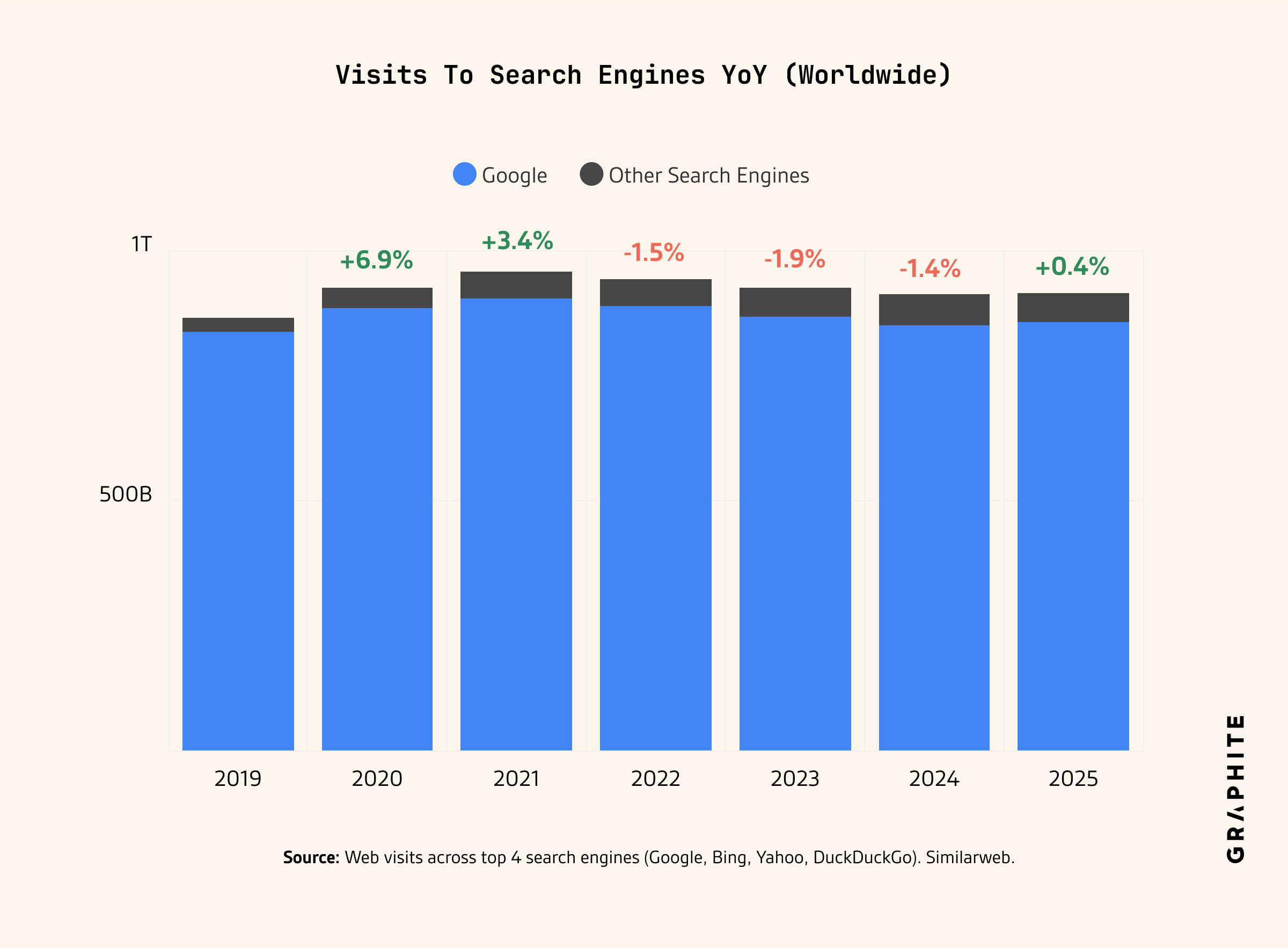
- There is no downward trend in visits to Google or to search engines as a whole.
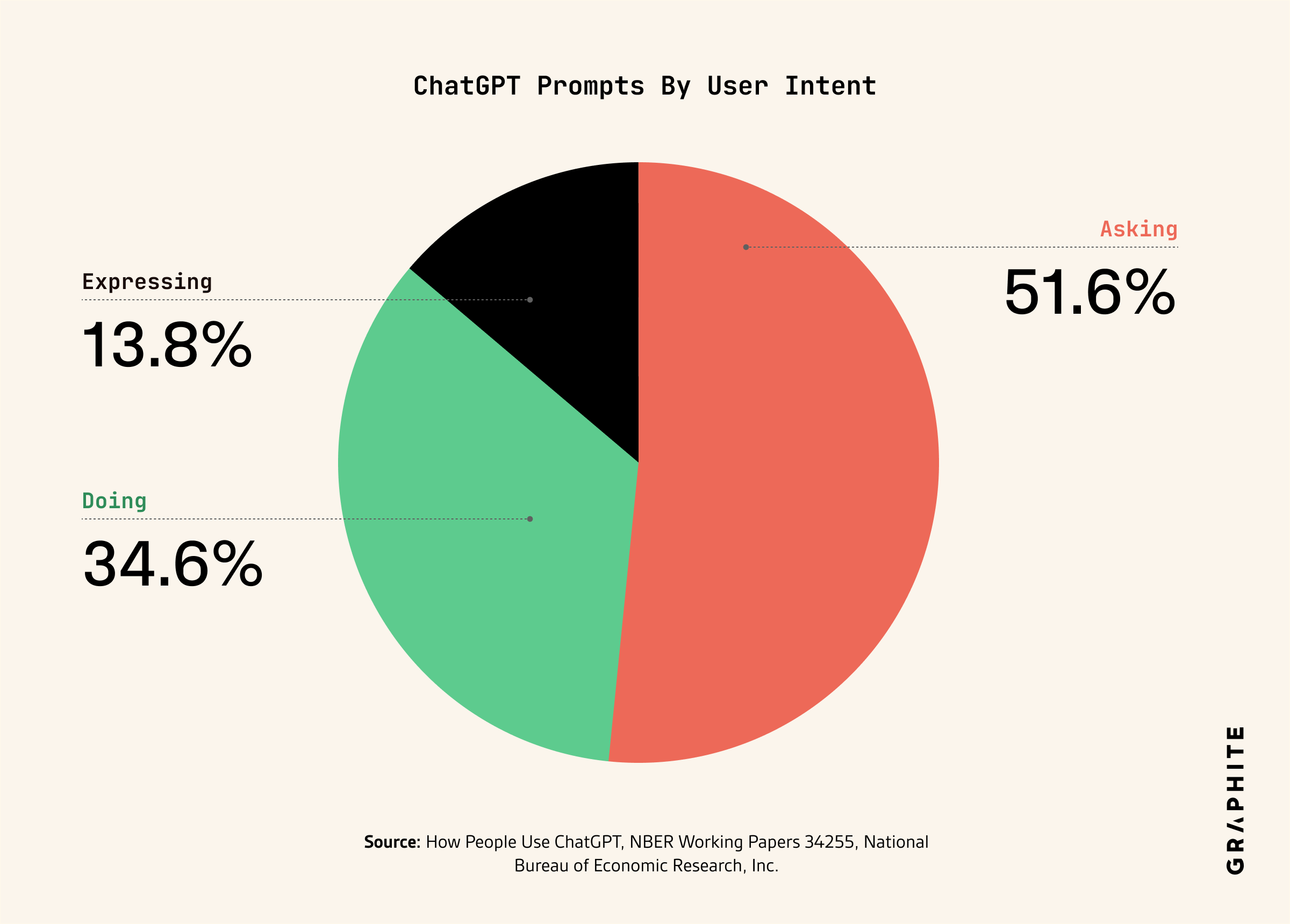
- 48% of prompts are Doing and Expressing prompts, which are not related to search. These prompts should be excluded when comparing to search.
- These projections assume that the search market is zero-sum. If ChatGPT goes up, Google necessarily must go down. However, the data show that the market is not zero-sum. Instead, the pie is getting bigger.
How People Use AI
83% of AI Usage Is on Mobile Apps
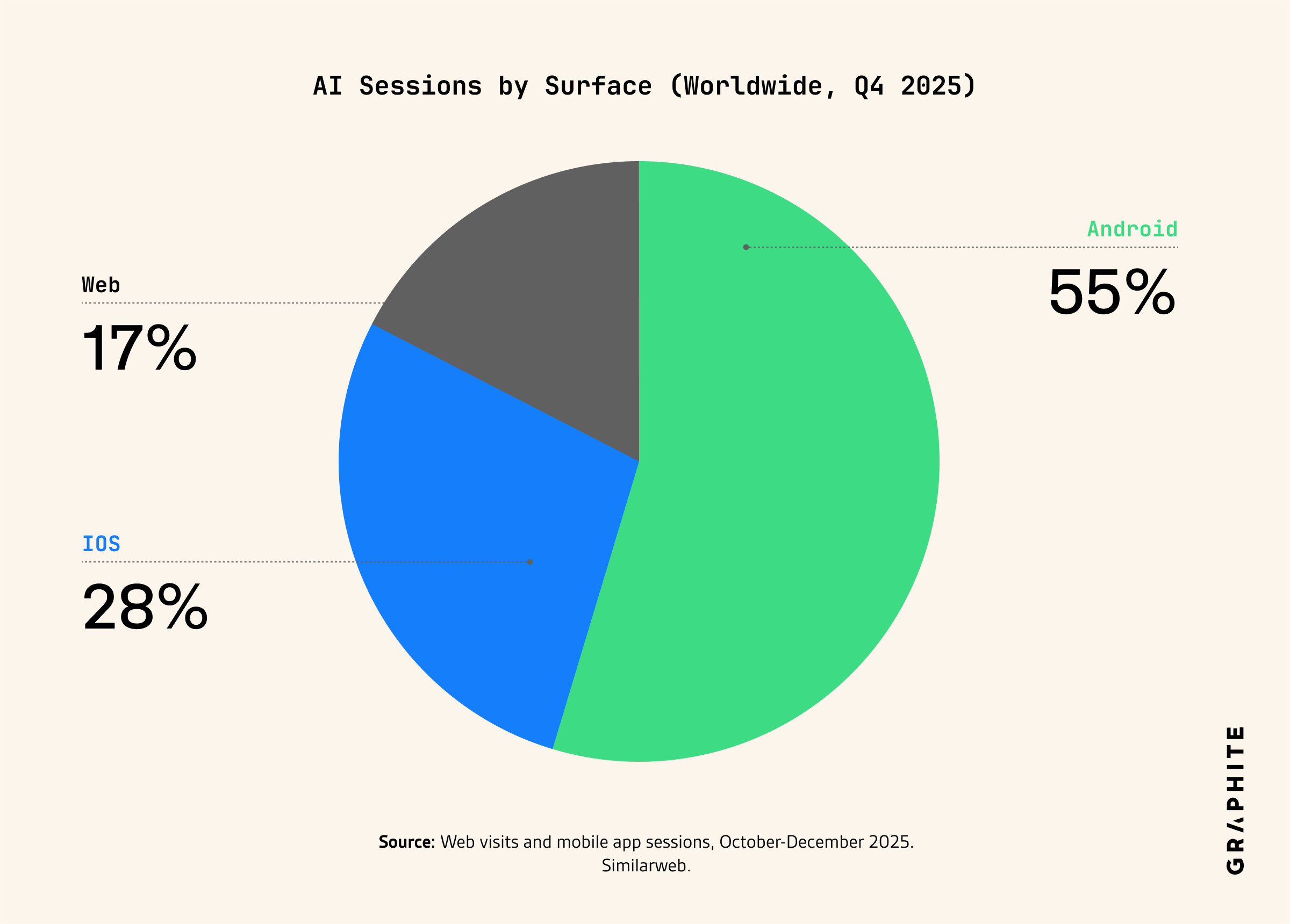
In the US, 75% of monthly sessions are on mobile apps compared to 25% on the web.
52% of Prompts Are Search-Related “Asking” Prompts
OpenAI published a study exploring a dataset of a random sample of approximately one million deidentified messages from logged-in consumer ChatGPT users between May 2024 and June 2025. Users use LLMs with multiple intents. OpenAI categorized prompts by user intents of Asking (“How do I create a budget for this quarter?”), Doing (“Rewrite this email to make it more formal”), and Expressing. Since Doing and Expressing intents do not relate to search, we can separate them from analysis when comparing AI search to traditional search. Instead, we only consider Asking prompts when comparing with search.
Not all “Asking” prompts are direct substitutes for traditional search queries. Many Asking prompts involve advice-seeking, multi-turn conversations, or complex questions that users may not have previously addressed through search engines at all (e.g., “How should I handle a difficult conversation with my manager?”). As a result, the comparison between AI Asking sessions and search engine visits is imperfect. We should interpret the Asking prompt based adjustments as an upper bound vs. an exact approximation.
Source: “How People Use ChatGPT,” NBER Working Papers 34255, National Bureau of Economic Research, Inc
Prompts by User Intent
Generative AI is a highly flexible technology that can be used in many different ways. “How People Use ChatGPT” is a study of over 1M prompts published by Harvard and OpenAI. The authors classified prompts by user intent. Asking queries are more likely to be Practical Guidance and Seeking Information. Doing queries are disproportionately Writing and Multimedia. Expressing queries are disproportionately Self-Expression.
We include details for how they defined these user intents.
Asking (51.6%)
Asking is seeking information or advice that will help the user be better informed or make better decisions, either at work, at school, or in their personal life. (e.g. “Who was president after Lincoln?”, “How do I create a budget for this quarter?”, “What was the inflation rate last year?”, “What’s the difference between correlation and causation?”, “What should I look for when choosing a health plan during open enrollment?”).
Doing (34.6%)
Doing messages request that ChatGPT perform tasks for the user. User is drafting an email, writing code, etc. Classify messages as “doing” if they include requests for output that is created primarily by the model. (e.g. “Rewrite this email to make it more formal”, “Draft a report summarizing the use cases of ChatGPT”, “Produce a project timeline with milestones and risks in a table”, “Extract companies, people, and dates from this text into CSV.”, “Write a Dockerfile and a minimal docker-compose.yml for this app.”)
Expressing (13.8%)
Expressing statements are neither asking for information, nor for the chatbot to perform a task.
Source: “How People Use ChatGPT,” NBER Working Papers 34255, National Bureau of Economic Research, Inc
Usage of Search Engines Is Flat, Not Declining
In a separate study published in January 2026, we showed that usage of traditional search engines has not decreased over the last 6 years despite many claims to the contrary.
AI Now Receives 45B Monthly Sessions Worldwide
In the US, AI now receives 5.4B monthly sessions.
Search & AI Are Not Zero-Sum, the Pie Is Getting Bigger
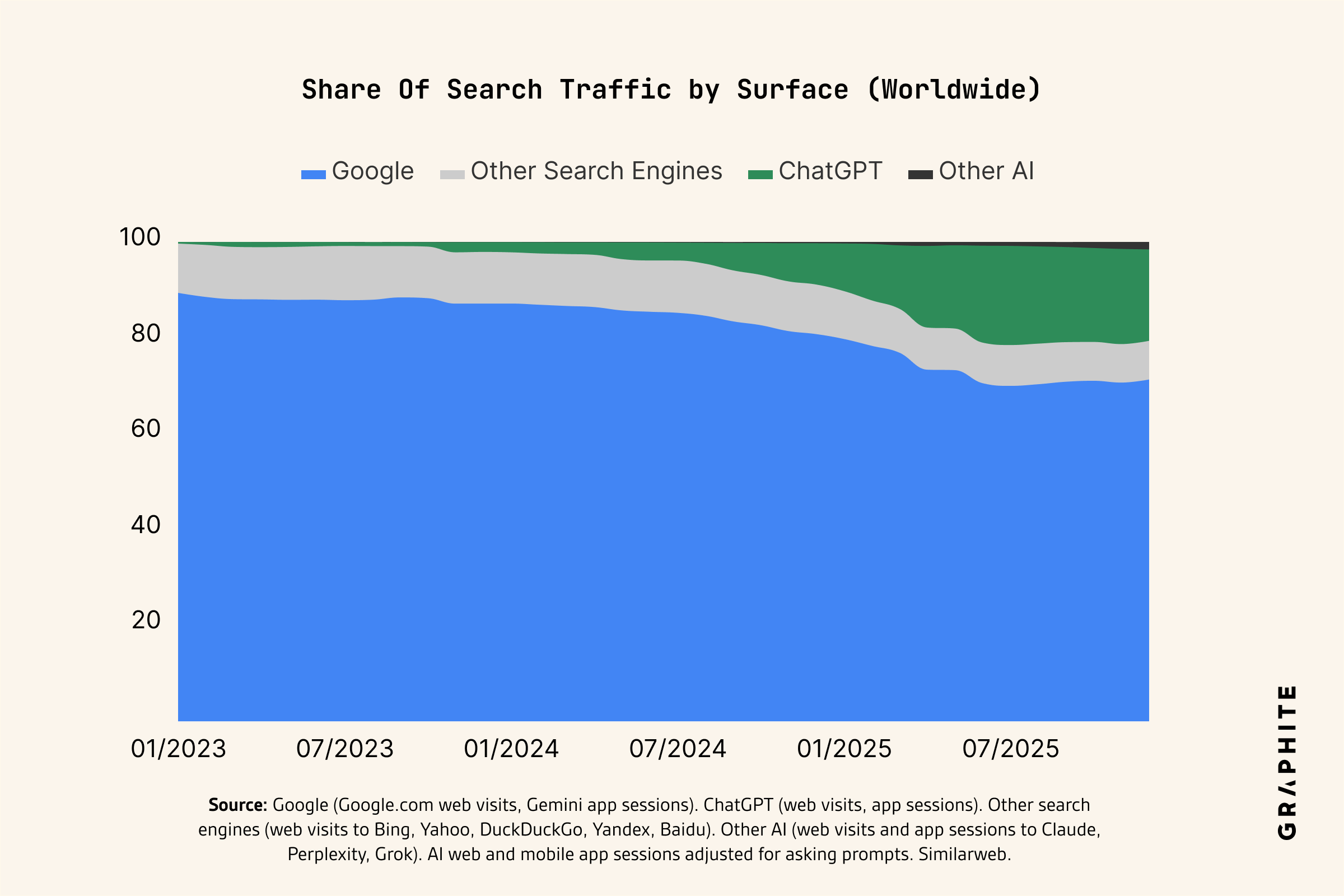
We can combine search and AI Asking prompts to see that the search pie is getting bigger. Since the launch of ChatGPT in November 2022, comparing Q1 2023 vs. Q4 2025, total usage of search via AI and search engines has increased by 26% worldwide.
ChatGPT Now Has 20% Share of Search Traffic Worldwide
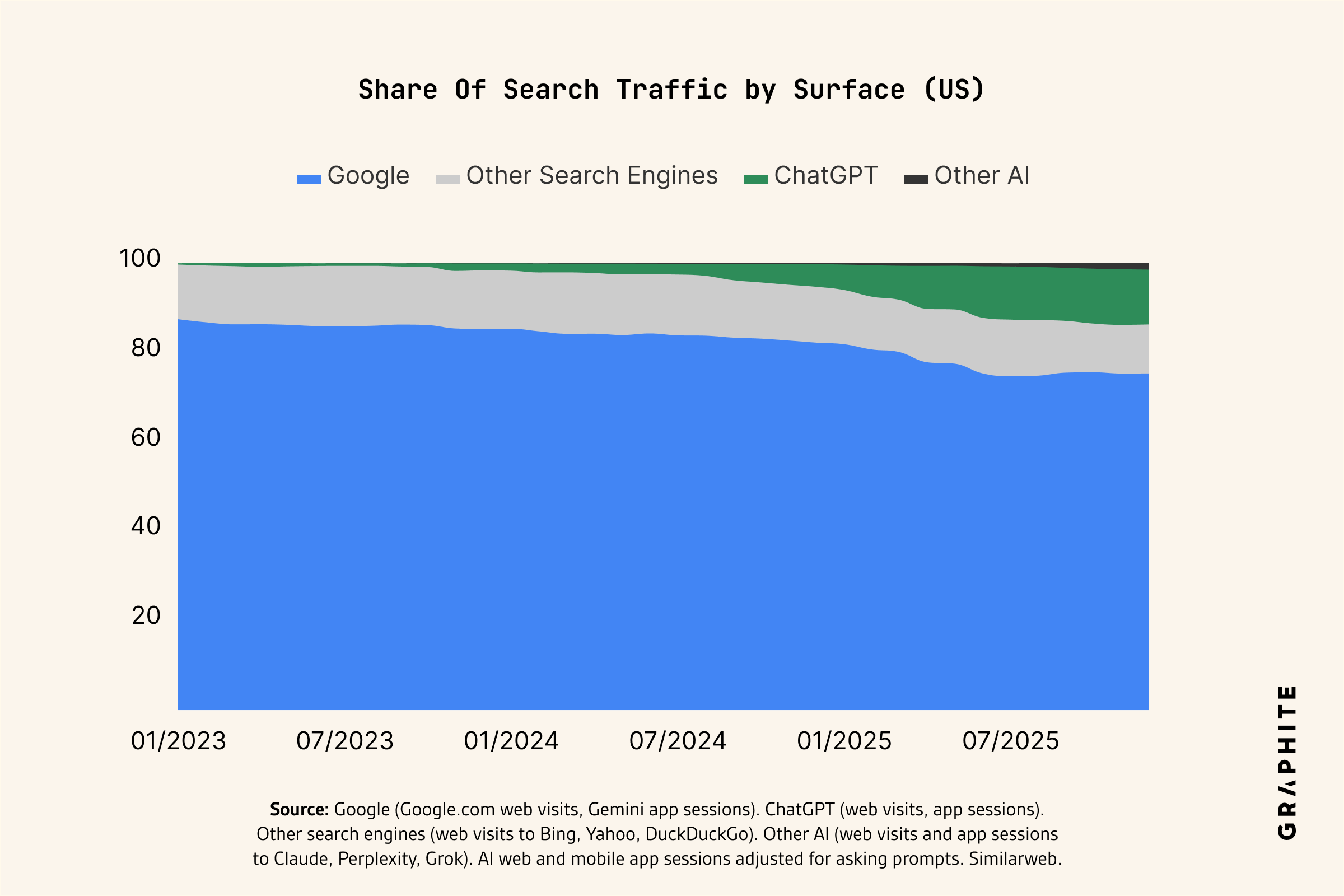
- For years, Google has controlled the search and discovery market. For the first time in over a decade, Google’s share of the search and discovery market has shifted.
- Worldwide, Google’s traffic share has decreased from 89% in 2023 to 71% in Q4 2025. ChatGPT now commands 20% of search worldwide, considering web and app usage and adjusting for only asking prompts.
- In the US, Google’s market share decreased from 88% in 2023 to 75%. ChatGPT has 12% traffic share.
- To compare Google, search and other LLMs, we combine Google Search with Gemini for asking prompts only. For ChatGPT, we consider web and app visits adjusted for asking only prompts. For other AI, we combine Perplexity, Grok, and Claude for asking prompts only. For other search we combine Yahoo, Bing, DuckDuckGo, and for worldwide we also include Baidu and Yandex.
- To adjust for Asking prompts, we use data from the ChatGPT + Harvard study, How People Use ChatGPT between July 2024 and June 2025. Prior to July 2024 we use the average of July–September 2024 and after June 2025 we use the average of April–June 2025.
Global vs. US Market Share
AI Is Larger Outside the US
Usage of AI Is Over 7x Larger Worldwide Than in the US
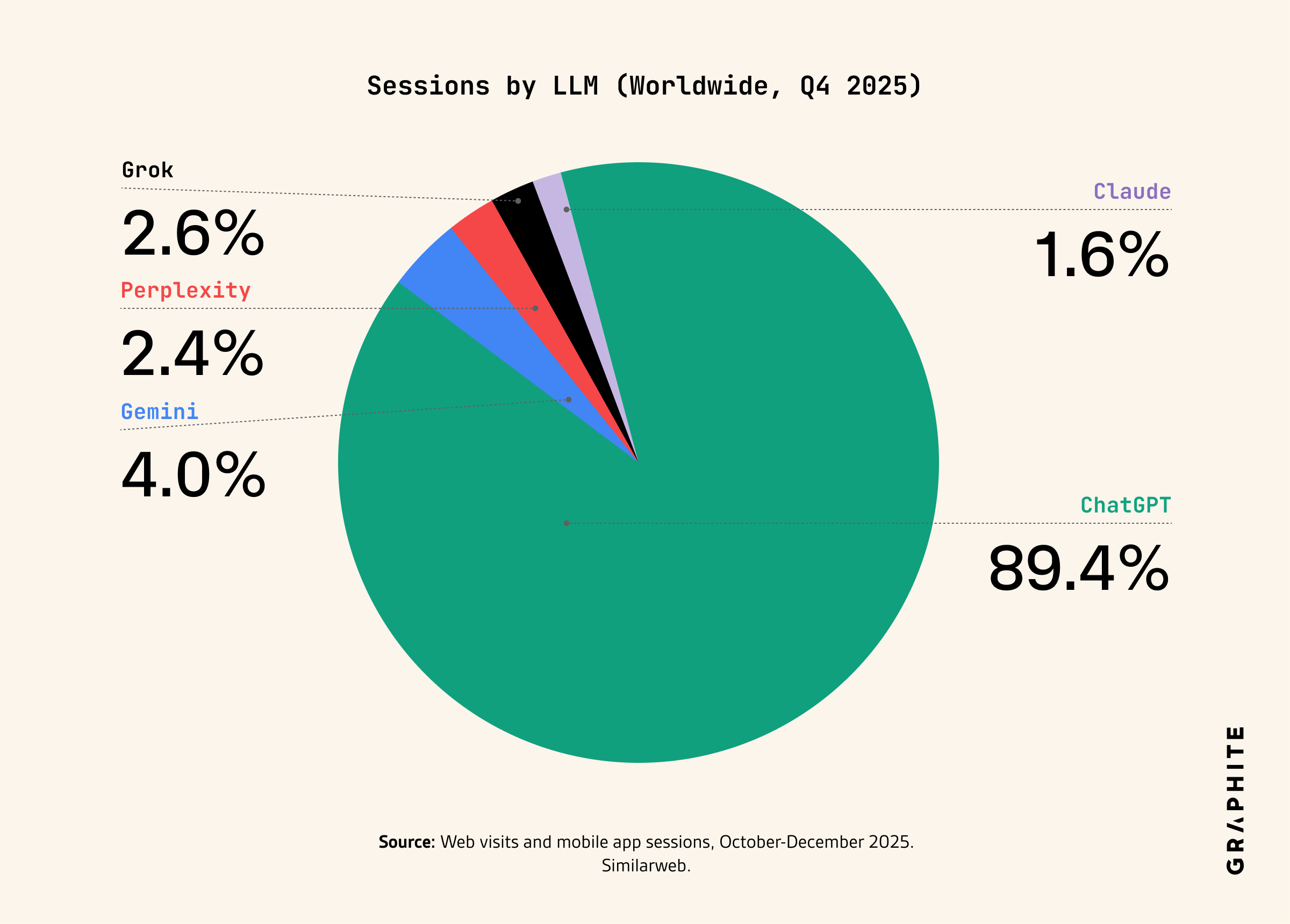
ChatGPT Owns 89% of the AI Market Share Worldwide
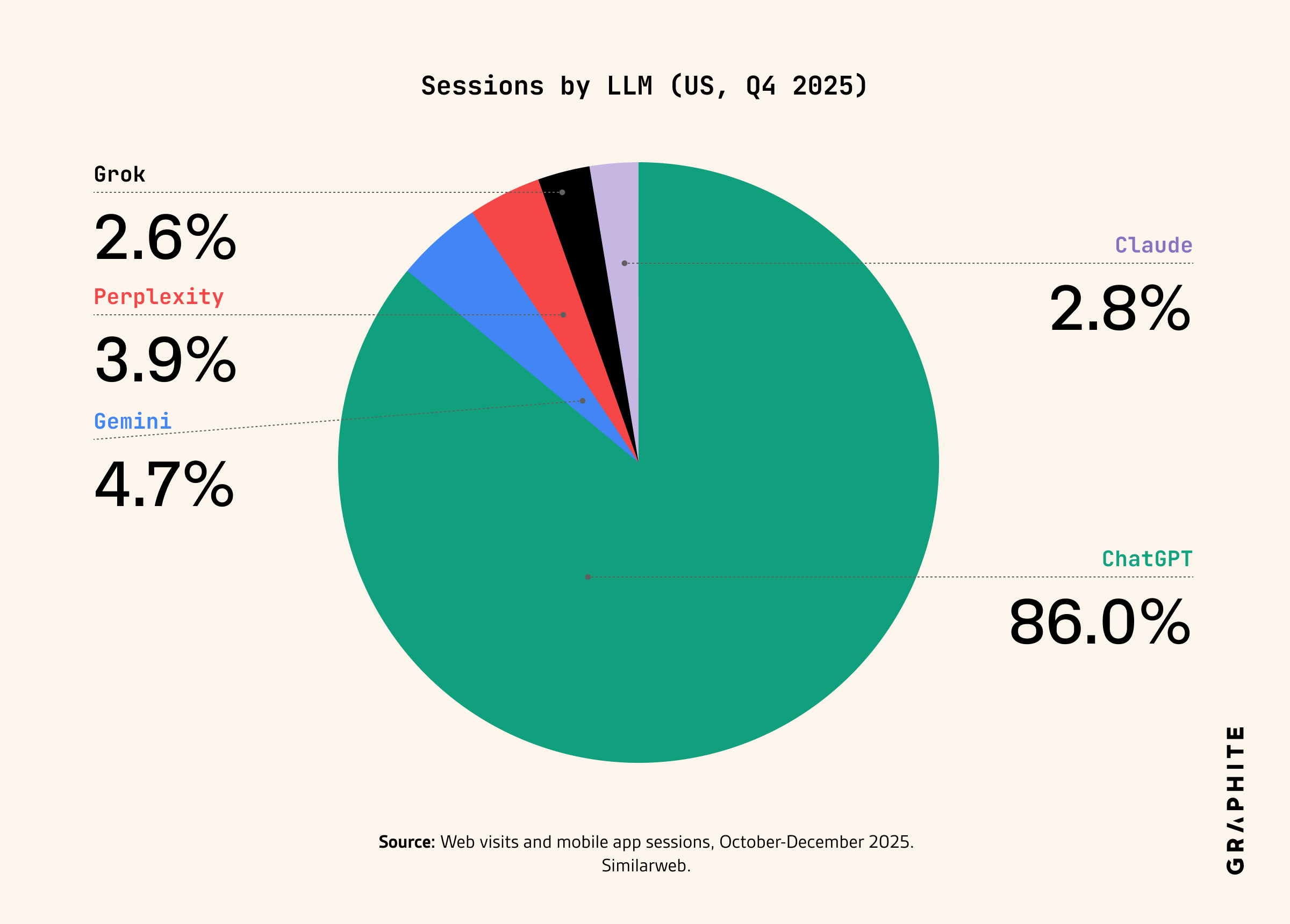
ChatGPT Owns 86% of the US AI Market Share
Zero-Sum Bias
When mobile apps first started, many people assumed a zero-sum bias and claimed that the growth of mobile apps would cause the death of the web. This same claim has been made about the growth of AI, causing the death of search. Just as the web never died, the same is true for search. Search has not declined in 6 years, and there is no evidence that it will.
The zero-sum bias is a cognitive bias where humans assume that gains in one area must come at the expense of losses in another. When a new market emerges, an incumbent market must decline. Sometimes this is true, and other times it is not.
The emergence of Netflix caused the death of Blockbuster. The internet caused the death of the Yellow pages. Therefore, the emergence of mobile apps means the death of the web. People increasingly searching on YouTube, Instagram, and TikTok means the death of Google. And today, the rapid growth of AI will result in the inevitable death of search.
While this narrative sounds compelling, the data tell a different story. The growth of AI is incremental to search. The pie is getting much bigger.
Methodology & Data Notes
Evaluation of Similarweb Data
First Party Data Correlation Analysis
We calculated the Pearson product-moment correlation coefficient of monthly click data in Google Search Console or Google Analytics vs. monthly session data from Similarweb for all search engines between September 2024 and November 2025. Similarweb data included all search engines, such as Bing and Yahoo while Google Search Console data includes only Google. We compare both US data and worldwide data.
Overall, in all but one case, the data had a high correlation. In most cases, the correlation was very high (>0.5). The median correlation was 0.86, which is considered very high.
Note: Pearson product-moment correlations are often confused with r² (coefficient of determination) correlations, which have higher thresholds of what is considered a strong correlation. Source
Similarweb vs. Google Search Console Pearson Product-Moment Correlation
| Worldwide | US | |
|---|---|---|
| Site 1 | 0.66 | 0.63 |
| Site 2 | 0.82 | 0.92 |
| Site 3 | 0.99 | 1.00 |
| Site 4 | 0.84 | 0.90 |
| Site 5 | 0.89 | 0.69 |
| Site 6 | 0.91 | 0.88 |
| Site 7 | 0.58 | 0.46 |
| Site 8 | 0.47 | 0.90 |
| Median | 0.83 | 0.89 |
Evaluation of Mobile App Data
We do not have access to mobile app data and thus cannot independently evaluate the correlation. We were only able to evaluate the correlation of Similarweb data with first-party web data.
Google Disclosures
In March 2025, Google publicly announced that as of January 2025, “We already see more than 5 trillion searches on Google annually.”
Data from Similarweb between January and December of 2024 show a total of 852.3B visits, 6.7 pages/visit, which sum to 5.7 trillion annual pageviews. This is consistent with Google’s announcement of “more than 5 trillion searches.”
ChatGPT Disclosures
In October, OpenAI CEO Sam Altman announced that ChatGPT had reached over 800M Weekly Active Users (WAUs).
Data from Similarweb for the preceding month of September 2025 showed 133M WAUs on Android, 310M WAUs on iOS, and 459 Monthly Unique Visitors on web. These all sum to roughly 902M WAUs with duplication. While we do not have deduplicated numbers across web and app, Similarweb numbers are roughly consistent with those disclosed by OpenAI.
Definition of Metrics
Visits
A “visit” to a website is counted when a visitor accesses one or more pages during a session. Subsequent pageviews are included in the same visit until the user is inactive for more than 30 minutes. If a user becomes active again after 30 minutes, that counts as a new visit. A new session will also start at midnight. (Reference)
Session (Apps)
A session is a period of time when a user interacts with an app. Session metrics are a primary measure of user engagement, as they capture how frequently and how long users interact with an app. (Reference)
Web Visits vs. App Sessions
Web “visits” are session counts with a 30-minute inactivity rule aggregated monthly, while app “sessions” reflect real app usage periods and are typically measured and analyzed on a daily engagement basis.
Monthly Visits (Web) measure how many times users visit a website. A “visit” (or web session) begins when someone loads a page and ends after 30 minutes of inactivity or at midnight. The metric simply sums all of these sessions over the course of a month.
App Sessions measure how often users actively use a mobile app. A session represents a period of interaction while the app is open and in use. Instead of a fixed 30-minute timeout rule in the documentation, app sessions are based on actual app engagement and are typically reported as sessions per user per day, along with average and total session time.
LLM Launch Dates
LLM Launch Dates
| LLM | Website Launch | iOS Launch | Android Launch |
|---|---|---|---|
| ChatGPT | November 2022 | May 2023 | July 2023 |
| Gemini | March 2023 | February 2024 | February 2024 |
| Perplexity | December 2022 | March 2023 | May 2023 |
| Grok | November 2023 | November 2023 | July 2024 |
| Claude | March 2023 | May 2024 | July 2024 |
Data Notes
- We use sessions instead of visitors or MAUs because sessions represent the overall usage of AI vs. the number of people who use AI. Also, if we compare the visitors of web and MAUs of apps across multiple AI products, there is significant duplication that we cannot account for. In other words, many people use multiple LLM products across web and mobile apps, which we cannot correct for. So, sessions is the cleanest metric to represent usage of AI.
- We use visits and sessions rather than searches or prompts. We do not have reliable data showing the # of searches or prompt behavior. It’s possible that search or LLMs are used more often per visit due to the different use cases.
- ChatGPT moved its LLM app domain from chat.openai.com to chatgpt.com in May 2024. Gemini changed its name from Bard (bard.google.com) to Gemini (gemini.google.com) in February 2024. For ChatGPT and Gemini, we combine the website data for domains to account for this.
- Grok originally launched on x.com/i/grok and moved to grok.com in January 2025. We are unable to see data prior to the domain change, so we exclude Grok website traffic prior to January 2025.
- Claude.ai website launched March 2023. However, we have missing data between March to June 2023, so we exclude these months. We do not have website traffic for November 2022 for ChatGPT.
- We exclude Yandex and Baidu from US search engine traffic data because their usage is very small.
- We were unable to get monthly sessions for LLM apps in some cases due to sparse data. So, we exclude these.
- To calculate the usage trends of AI for Asking, Doing, and Expressing we applied the % composition of search-related and non-search-related prompts provided by OpenAI. This assumes that the composition of prompts from ChatGPT is similar to the composition of prompts on Gemini, Perplexity, Grok, and Claude. As of October–December 2025, ChatGPT accounts for 89.4% of sessions. So, if there is a difference in the composition of other AI products, the error rate should be relatively low. The prompt breakdown is provided for July 2024 to June 2025. For the months prior to July 2024, we apply the average of July 2024 – September 2024, and for the months after June 2025, we apply the average of April 2025 – June 2025.
- Several search engines have mobile apps where users can search. However, the usage of these apps is relatively low. For this reason, we exclude these from the data.
Incentives of the Author
The author, Ethan Smith, is the CEO of Graphite.io, a growth agency that offers services for SEO and AEO. It is in the financial interest of the author to argue that SEO and AI are large and growing. All arguments are supported by data, for which we provide raw data and links to the original sources.
Researchers

Founder and CEO of Graphite, the research-driven growth agency behind work for Webflow, Adobe, and Upwork. Teaches SEO and AEO at Reforge and is an adjunct professor at IE Business School. Research published in the Financial Times, Axios, and The Atlantic. Previously a growth advisor to Masterclass, Robinhood, and Honey.
Read Full Bio