How To Get Your Brand Mentioned in ChatGPT

Key Takeaways
How to hire for AEO. AEO problems are often undefined, e.g., "figure out a Reddit strategy". Most people can follow prescriptive processes but struggle with open-ended problems. Established channels (e.g., paid ads) rely on known processes; AEO requires invention.
Avoid derivatives of derivatives (AI or human). Avoiding rewritten on-site content requires quality and information gain. Uniqueness is created through: expert input and quotes, product-specific use cases, and proprietary or company-specific metadata.
AI + unique data works. AI content performs when summarizing proprietary or non-public information.
Effective pattern: unique input → AI summarization → additive output. AI should function as a co-pilot within structured workflows. Strong use cases include FAQs, product and feature content, and category pages driven by structured, unique data. AI workflows fail when they are thin wrappers around ChatGPT without unique inputs.
LLM answer variability is probabilistic, not mysterious. Answer differences come from probability distributions, not user-level personalization. Prompt tracking is meaningful when questions are asked multiple times — repeating prompts (≈7–10 times) provides a reliable view of answer distribution.
Summary
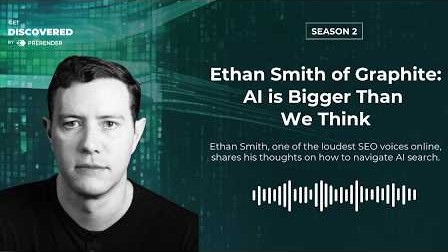
Ethan Smith — CEO of Graphite — joins Niklas Buschner for a 70-minute walkthrough of Answer Engine Optimization (AEO): the discipline of getting recommended inside ChatGPT, Claude, and Gemini.
Getting mentioned by citations is actually probably more worth the time than it would be for link building.
Ethan Smith, CEO of Graphite
Ethan breaks down AEO strategy across team structure, content, and tooling, arguing that off-site citation building (Reddit, G2, YouTube) is more novel and high-leverage than traditional SEO tactics, and that AI-generated content only works when it summarizes genuinely unique inputs rather than recycling public information.
On measurement, he explains that attribution is fundamentally messy, given that most LLM conversions are zero-click, and recommends that teams focus on prompt visibility tracking and self-reported customer attribution while accepting the noise, noting that answer variability is probabilistic, not personalized, so asking the same prompt 7–10 times yields a reliable enough distribution.